

2026-07-10 15:55:54
In modern electronic systems, electromagnetic interference (EMI) has become a major challenge for engineers and manufacturers.With the increasing use of switching power supplies, electric vehicle chargers, solar inverters, and industrial Automation equipment, high-frequency noise generated during operation can affect system stability and product reliability.
A Common Mode Choke is one of the most effective components for reducing unwanted electromagnetic noise.It is widely used as an important EMI filter component to improve electromagnetic compatibility (EMC) performance and ensure reliable operation of electronic equipment.
However, choosing the right common mode choke is not only about selecting a component with suitable dimensions. Engineers need to consider current rating, impedance characteristics, operating frequency, core material, installation space, and application requirements. 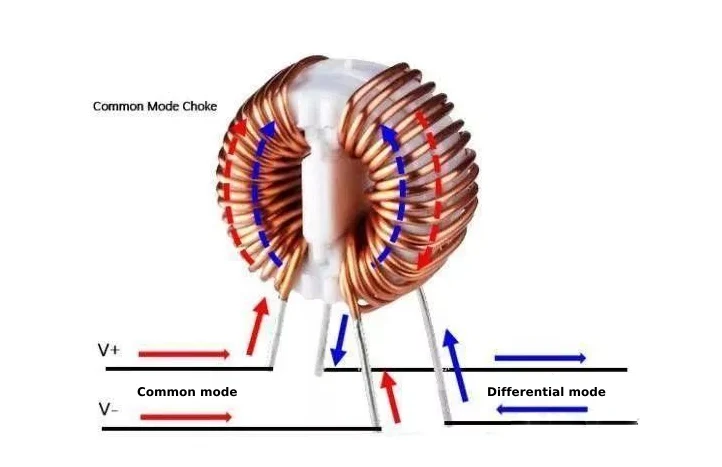
A Common Mode Choke is a passive magnetic component designed to suppress common mode noise in electrical circuits. It usually consists of a magnetic core and two or more windings placed around the core.
During normal operation, the useful current flows through the windings in opposite directions, causing the magnetic fields to cancel each other. When common mode noise appears, the magnetic fields combine and create high impedance, preventing unwanted interference signals from passing through the circuit.
Because of this working principle, common mode chokes are widely used in power systems, communication equipment, automotive electronics, and industrial applications where EMI suppression is required.
Modern electronic devices operate at higher switching speeds and power densities, which increases the possibility of electromagnetic noise generation. Without proper filtering, EMI problems may lead to equipment malfunction, communication interference, and failed EMC certification.
Many electronic products must pass strict electromagnetic compatibility testing before entering the market. A suitable common mode choke filter helps reduce conducted emissions and improves the ability of products to meet international EMC standards.
Noise generated by switching circuits, motors, and power conversion systems can affect sensitive electronic components. Common mode chokes help block unwanted high-frequency interference while allowing normal power signals to pass.
Effective EMI control helps protect control boards, sensors, communication modules, and other sensitive components, improving the overall reliability and service life of electronic equipment.
The rated current is one of the most important factors when selecting a common mode choke inductor. The component must handle the operating current without excessive temperature rise or performance degradation.
If the current rating is too low, problems such as core saturation, increased losses, and overheating may occur. For high-power applications such as EV chargers and solar inverters, a high current common mode choke is often required.
The main purpose of a common mode choke is EMI suppression. Therefore, the impedance characteristics must match the frequency range of the noise generated by the application.
Selecting an unsuitable choke may result in poor filtering performance and make it difficult for the product to pass EMC testing.
Different electronic systems generate different noise frequencies. Switching power supplies, motor drives, communication devices, and power converters require different filtering characteristics.
Engineers should select a common mode choke according to the actual operating frequency range to achieve better EMI filtering performance.
The magnetic core directly affects the performance of a common mode choke. Ferrite cores are widely used because they provide excellent high-frequency noise suppression. For demanding applications, advanced magnetic materials can provide higher permeability and improved filtering performance.
Modern electronic products often have limited installation space. Engineers need to consider component size, mounting method, thermal conditions, and mechanical requirements when selecting a choke.
Switching power supplies generate high-frequency noise during voltage conversion. Common mode chokes help reduce conducted interference and improve power system stability.
Solar inverter systems require effective EMI filtering during DC to AC conversion. Common mode choke filters improve electromagnetic compatibility and protect sensitive components.
EV charging systems involve high power conversion processes. Common mode chokes help reduce interference between charging equipment and electrical networks.
CNC machines, robots, motor controllers, and PLC systems require stable electrical performance. Common mode chokes help reduce electrical noise in complex industrial environments.
Different applications have different electrical and mechanical requirements. A standard component may not always provide the best performance.
A professional custom common mode choke manufacturer can optimize designs according to:
Required inductance value
Current capacity
Operating frequency
Installation space
Application environment
Selecting the right Common Mode Choke requires careful consideration of electrical performance, application conditions, and product requirements.
By choosing the correct current rating, impedance characteristics, core material, and design structure, engineers can achieve better EMI suppression, improved EMC performance, and higher product reliability.
For manufacturers of power electronics, EV charging systems, renewable energy equipment, and industrial products, working with an experienced common mode choke supplier provides a reliable path toward optimized and stable solutions.

Specialised in automated winding equipment and system development, production, sales and technical services as one of the high-tech enterprises.

+0769 82312151
+86 135 8090 8886
+86 132 6737 9998
3F, No.51 Minghua Road, Liangjia Village, Shijie Town, Dongguan City, Guangdong Province, China
Copyright © 2026 Dongguan Zhiqiang Electronic Technology Co., LTD | Privacy Policy | Terms and Conditions
