
2026-09-05 16:55:39
A toroidal coil Winding Machine is a specialized piece of equipment designed to wind copper wire around a toroidal core. Toroidal coils are commonly used in inductors, transformers, chokes and other electronic components where compact size, efficient magnetic performance and consistent winding quality are important.
Compared with winding a conventional bobbin, toroidal coil winding requires the wire to pass repeatedly through the center of a ring-shaped core. This creates unique challenges for wire handling, winding tension, turn accuracy and production efficiency. A professional toroidal coil winder helps automate these processes and improve consistency from coil to coil.
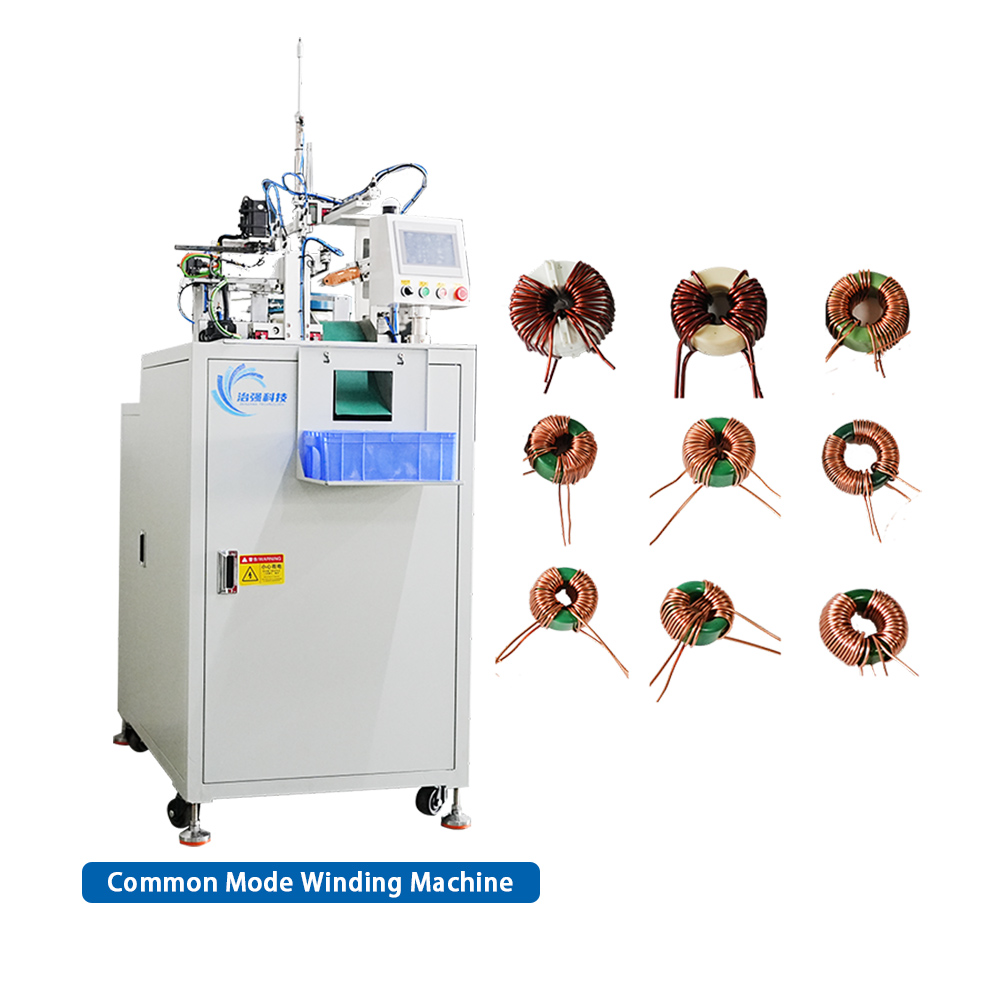
A toroidal Coil Winding Machine is designed specifically for winding wire around ring-shaped magnetic cores. Depending on the production requirements, the machine can support manual assistance, semi-automatic operation or a fully automatic toroidal winding machine configuration.
The basic purpose of the machine is to control how wire is transferred around the toroidal core while maintaining stable winding conditions. Important factors can include wire tension, winding speed, winding position and the number of turns.
For manufacturers producing inductors, toroidal coils or choke components, a dedicated toroid winding machine can provide more consistent results than relying entirely on manual winding.
The working principle of a toroidal coil winding machine is based on continuously transferring wire around the ring-shaped core.
Although machine configurations can vary, the winding process generally includes several key stages.
The copper wire is supplied from a wire spool and guided into the winding system. Before winding begins, the machine needs to maintain appropriate control of the wire to reduce unnecessary variation during the process.
The toroidal core is positioned in the winding area. Because the core has a closed ring shape, the winding system must transfer the wire through the center of the core during each winding cycle.
Stable positioning is important because movement of the core during winding can affect winding distribution and coil consistency.
This is one of the main differences between a conventional coil winding machine and a toroidal coil winding machine.
Instead of simply rotating a bobbin, the machine transfers the wire around and through the center of the toroidal core. The winding mechanism repeats this process until the required number of turns has been completed.
Wire tension is an important part of the toroidal coil winding process. Excessive tension may place unnecessary stress on the wire or affect the winding result, while insufficient tension can make it difficult to achieve a stable and consistent coil structure.
A properly configured toroidal coil winder helps maintain more stable winding conditions throughout the production process.
The machine continues winding until the specified number of turns is reached. For electronic components that require repeatable electrical performance, consistent turn counts can be an important production requirement.
Automatic Winding Equipment can help manufacturers reduce variation between coils and improve production repeatability.
The closed structure of a toroidal core creates several challenges that are not present when winding open bobbins.
The wire must repeatedly pass through the center of the core.
Wire handling must remain stable throughout the winding process.
Winding tension needs to be controlled consistently.
Different core sizes may require different machine configurations.
Wire diameter can affect the winding process and equipment requirements.
Production speed must be balanced with winding quality.
For these reasons, manufacturers often use dedicated toroid winding machines when producing toroidal coils in larger quantities.
Manual winding can be suitable for some low-volume applications or specialized production requirements. However, manual processes may depend heavily on operator skill and can make it more difficult to maintain consistent production results.
An automatic toroidal winding machine can help improve production consistency by controlling key parts of the winding process.
Suitable for some small production quantities.
Requires greater operator involvement.
Production consistency may depend on operator experience.
Can require more time for repetitive winding operations.
Helps improve production repeatability.
Can reduce dependence on manual operation.
Supports more consistent winding conditions.
Can improve efficiency for repeated production.
A toroidal coil winding machine can be used in the production of different electromagnetic components that use ring-shaped cores.
Typical applications may include:
Toroidal inductors
Toroidal transformers
Choke coils
EMI filtering components
Power electronics components
Electronic control systems
The specific machine configuration should be selected according to the core size, wire diameter, coil design and production requirements.
When selecting a toroidal coil winding machine, manufacturers should consider more than just machine speed.
Important factors can include:
Toroidal core size: The machine should be compatible with the required range of core dimensions.
Wire diameter: Different wire sizes can require different winding configurations.
Number of turns: The equipment should support the required winding specifications.
Production volume: Output requirements can influence the level of automation needed.
Product changeover: Manufacturers producing different coil types may require flexible machine adjustment.
Winding consistency: Repeatability is important when producing large quantities of similar components.
Choosing the right machine requires matching the equipment configuration with the actual coil design and production requirements.
A toroidal coil winding machine can help manufacturers improve efficiency and consistency when producing ring-core electromagnetic components. By controlling wire handling and the winding process, a dedicated toroidal coil winder can support more repeatable production compared with fully manual operations.
For manufacturers producing inductors, chokes and other wound electronic components, selecting a suitable toroid winding machine should be based on the specific core dimensions, wire specifications and production requirements.
To learn more about specialized winding equipment for coil production, you can explore our Differential Mode Winding Machine and discuss the appropriate configuration for your application.

Specialised in automated winding equipment and system development, production, sales and technical services as one of the high-tech enterprises.

+0769 82312151
+86 135 8090 8886
+86 132 6737 9998
3F, No.51 Minghua Road, Liangjia Village, Shijie Town, Dongguan City, Guangdong Province, China
Copyright © 2026 Dongguan Zhiqiang Electronic Technology Co., LTD | Privacy Policy | Terms and Conditions
