
2025-12-18 16:29:58
Selecting the right cable Winding Machine is a decision that affects throughput, product quality, labor cost, and long-term flexibility of your wire and cable production line. Whether you manufacture thin enamelled copper for motors, heavy power cable, or specialty cords, the winding stage—where the conductor is formed into coils or spools—must match your production targets and product specifications.
Before you look at machine models, document exactly what you produce now and what you might produce in the next 2–5 years. Key attributes to record:
Conductor type and material (e.g., copper wire, aluminum, tinned copper). If you make copper coils, you'll want features tailored to copper Coil Winding Machine demands.
Conductor diameter range (AWG / mm).
Insulation type (bare, enameled, PVC, rubber, silicone).
Finished package type: spool, drum, hank, or coil. (If you use spools, search for spool winding machine capabilities.)
Target coil weight/length and allowable tension tolerance.
Production volume (pieces per shift/day) and cycle time targets.
Environmental constraints: floor space, power, clean room or dusty environment.
Knowing these answers will immediately narrow choices between specialized machines—like a cord winding machine for small cord sets vs. heavy-duty wire winding machine models for bulk copper wire.
Cable winding machines come in several forms. Choose the family that aligns with your throughput and labor strategy:
Manual / Semi-Automatic Winding Machines
Best for low-volume runs, prototyping, or varied batch sizes. Operator loads/unloads spools and starts the winding cycle. Lower capital cost but higher labor overhead.
Fully automatic winding machines
Integrated with spool dispensing, tension control, metering, cutting, and automatic unloading. Ideal for high-volume lines where consistency and minimised labor are priorities. Often described in industry listings as Automatic Wire Winding Machines or electric wire coil winders.
Spool / drum-specific machines
Machines designed for spool winding (spool winding machine) usually include spindle adaptors, flange guards, and accurate layering control. If your packaging is spool-based, a spool-focused model reduces packaging rework.
Center-wind vs. traverse-wind
Center-wind (coil winder) forms a pile on a flange or coil former. Traverse-wind machines cross the wire back and forth to create even layers—important for spools and tight-tolerance coils.
Specialized cord winders
Cord winding machine models handle thicker, co-extruded, or pre-formed cords where flexibility and bending radius are important.
Specialized copper winding machines
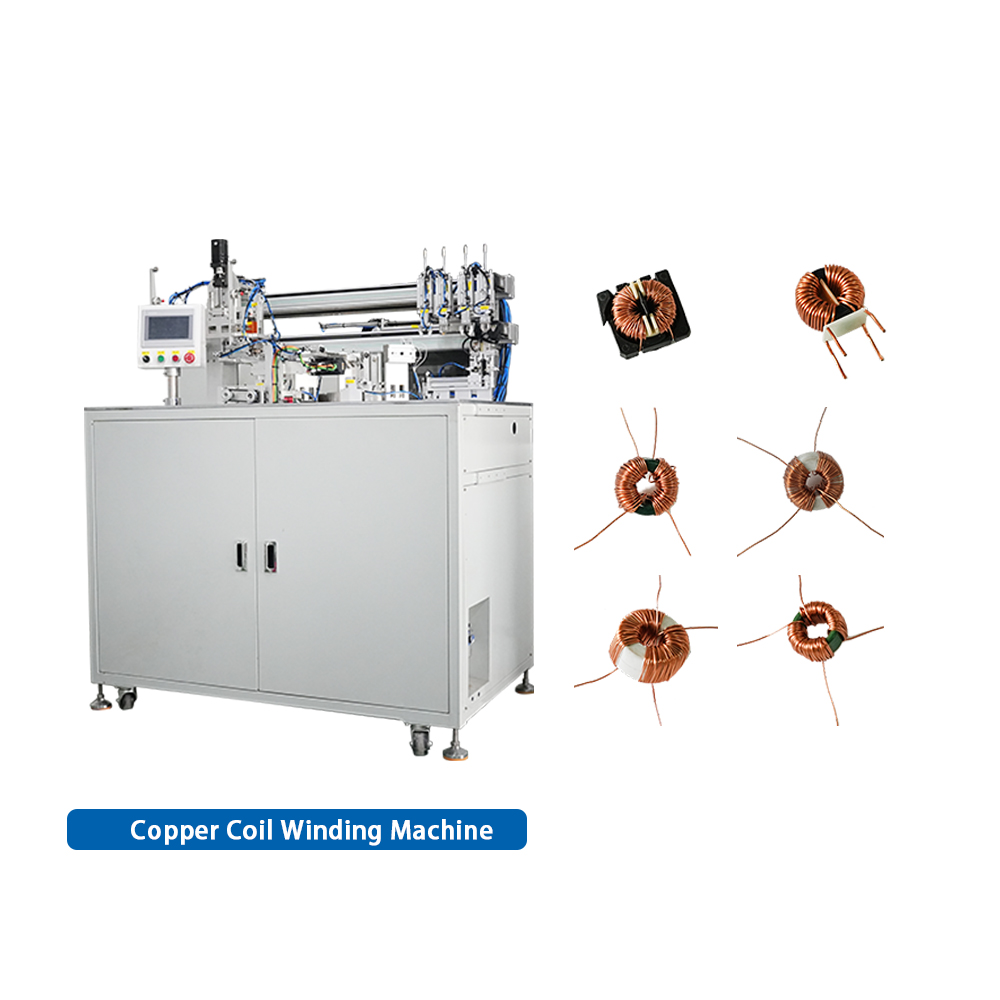
If your main product is copper conductor, look at copper wire winding machine or copper coil winding machine designs that offer higher-precision tension control and cooling/abrasion protections specific to soft copper.
When comparing models, evaluate these technical features closely. They determine product quality consistency and the machine’s suitability for your wire types.
Accurate, repeatable tension control prevents deformation, breakage, and insulation damage. Look for closed-loop tension systems with digital feedback. For copper wire (soft and ductile), precise control is essential.
Layering precision impacts coil stability and pay-off performance. For spools, choose machines with programmable traverse profiles and adjustable wrap counts per layer.
Peak line speed and acceleration/deceleration capability affects cycle time. Match machine speed to upstream/downstream equipment (drawing lines, insulation lines). High-speed electric wire coil winders should also provide smooth acceleration to avoid whipping or slippage.
Integrated counters (length, turns, or weight-based cutoffs) ensure each coil meets spec. If you need strict length accuracy, favor machines with optical encoders or roller meters.
Interchangeable spindles and chucks let you handle various spool bore sizes and flange types—useful if you produce mixed packaging sizes with the same machine.
For bare copper or sensitive insulation, protective guides, edge rollers, and insulating sleeves reduce abrasion. Machines marketed for copper coil winding machine use smoother guides and sometimes vacuum-assist systems.
Look for optional add-ons such as TTR (turn-to-turn resistance) checks, visual inspection cameras, and inline weighing to catch defects immediately.
A modern PLC with an intuitive HMI allows recipe storage for multiple products, remote diagnostics, and easier operator training. This is standard on most reputable wire winding machine manufacturers.
A common mistake is choosing a standalone machine without planning interfaces. Check:
Tension compatibility with pay-off and take-up equipment.
Electrical and communication protocols (Ethernet/IP, Modbus) for line integration.
Mechanical alignment and conveyor/robot compatibility for automated loading/unloading.
Space and foundation needs if the machine needs anchoring or vibration isolation.
For high-throughput automated lines, prefer models designed as part of a production cell. Many wire winding machine manufacturers offer customized integration services.
Ask yourself whether your production mix requires a flexible multi-product machine or a specialized high-speed unit:
High-mix, low-volume: choose modular, quick-change machines with recipe-based parameters, easy spindle swaps, and programmable traverse profiles. Semi-automatic or lower-speed automatic spool winding machine models excel here.
High-volume, single-product: a dedicated, high-throughput electric wire coil winders model with minimized changeover time will deliver the best ROI.
Copper-specific production: if copper wire is your primary product, a specialized copper wire winding machine or copper coil winding machine with dedicated features (soft-material handling, specific braking systems) is worth the investment.
When sourcing, treat the vendor as a partner. The label wire winding machine manufacturers covers wide quality differences. Use this checklist:
Reputation and references: Request references in your product niche. Ask to see case studies of similar installations.
Customization capability: Can they adapt the machine for your spool types, lengths, and materials?
After-sales support: Look for local service, spare parts availability, and training programs.
Warranty and uptime guarantees: Check for realistic MTBF and SLAs.
Compliance and safety: CE, UL, or region-specific certifications; machine guarding and lockout features.
Software openness: Is PLC software proprietary? Can you access logs for troubleshooting?
Lead time and delivery: Consider manufacturer location relative to your plant for faster spare delivery and commissioning.
Price transparency: Confirm what is included—hoists, spindles, fixtures, sensors, and installation.
Get written proposals from multiple wire winding machine manufacturers and compare total cost of ownership, not just headline price.
Price is only one part of the decision. Account for:
Capital cost and financing.
Installation, commissioning, and operator training.
Expected uptime and mean time to repair.
Consumable parts (guides, bearings, belts).
Energy consumption—especially for larger electric wire coil winders.
Labor savings from automation (calculate payback period).
Quality improvements reducing rework and warranty claims.
Run a simple ROI model: estimate the incremental throughput or labor savings, subtract incremental costs (consumables, maintenance), and compute payback months. Don’t forget opportunity cost for delayed product launches due to insufficient winding capacity.
A reliable maintenance plan is crucial:
Identify critical wear parts and ensure spare availability (spindles, slip rings, tension rollers).
Ask for recommended preventive maintenance schedules and common fault lists.
Insist on operator training during commissioning—winding recipes, troubleshooting, and safety.
For in-house engineers, request access to wiring diagrams and PLC schematics.
A solid service contract from the manufacturer reduces downtime and avoids costly line stoppages.
Buying undersized machines: Don’t over-optimize for current volumes alone. Plan capacity buffers and future product lines.
Ignoring interfaces: Poorly integrated machines create bottlenecks. Standardize communication protocols.
Underestimating tension needs for copper: Copper’s ductility requires smooth tension control to prevent bird-nesting or stretching.
Skipping factory acceptance tests (FAT): Always perform FAT or request video demonstrations with your wire specs before shipment.
Neglecting safety and guarding: Fast rotating spindles and high-tension lines can be hazardous—ensure proper guarding and e-stop systems.
Use this checklist when you evaluate shortlisted machines:
Product compatibility: diameter, insulation, spool type.
Throughput rating vs. your target.
Tension control type and accuracy.
Traverse and layering precision.
Metering/length/weight accuracy.
Degree of automation: manual, semi, full.
Integration interfaces (PLC, I/O, mechanical).
Footprint and utilities (power, compressed air).
Spare parts list and lead times.
Warranty, training, and service SLA.
Price and TCO estimate.
FAT plan and acceptance criteria.
Small electronics shop producing low volumes of enamelled magnet wire: a semi-automatic wire winding machine with easy changeover and manual spool loading is cost-effective.
Medium-sized cable manufacturer moving from manual coiling to semi-automated spooling: invest in a spool winding machine with programmable traverse, tension control, and basic automation to reduce labor and improve consistency.
High-volume industrial line for power cables or large copper coils: choose a fully automated electric wire coil winders system with integrated pay-off, tension control, in-line cutting, and robotic palletizing to maximize uptime.
Specialty cord producer (e.g., audio cords, appliance cords): a dedicated cord winding machine with careful bend-radius control and insulation-safe guides prevents damage to finished products.
Request bundled pricing for spindles, fixtures, and tooling.
Ask for a trial run or sample coils produced using your exact wire and spool.
Negotiate spare parts kits and a training package into the initial purchase.
Include acceptance criteria in the contract (tension variance, length accuracy, cycle time).
Seek phased payments linked to milestones: design approval, FAT, successful installation.
Q: Can one machine handle both copper wire and insulated cord?
A: Possibly, if the machine has modular tooling, programmable tension, and adjustable traverse systems. However, copper (bare/enamelled) demands gentler handling; verify with your supplier whether their model supports both without excessive changeover complexity.
Q: How important is tension control for a spool winding machine?
A: Extremely important—tension affects coil stability, insulation integrity, and pay-off performance. Accurate, adjustable tension systems are a must for professional output.
Q: Are there turnkey suppliers for full winding lines?
A: Yes—many wire winding machine manufacturers provide turnkey solutions that include pay-off, winding, metering, and packaging. Turnkey options shorten integration time but may cost more upfront.
Q: What keywords should I use when searching for suppliers?
A: Use terms like wire winding machine, spool winding machine, electric wire coil winders, cord winding machine, and copper wire winding machine to find relevant vendors and product pages.
Choosing the right cable winding machine is a strategic investment: the right machine improves throughput, enhances quality, reduces labor, and sets your plant up for future product variety. Start from your product profile, evaluate machine types (manual, semi-automatic, fully automatic), and prioritize tension control, traverse accuracy, and integration capability. Vet suppliers carefully—ask for FATs, references, and clear TCO calculations—and build service and spare parts into the purchase. Whether you search for a general-purpose wire winding machine, a dedicated spool winding machine, or a bespoke copper coil winding machine, the thorough selection process outlined here will help you match technology to business goals.

Specialised in automated winding equipment and system development, production, sales and technical services as one of the high-tech enterprises.
+0769 82312151
+86 135 8090 8886
+86 132 6737 9998
3F, No.51 Minghua Road, Liangjia Village, Shijie Town, Dongguan City, Guangdong Province, China

Copyright © 2026 Dongguan Zhiqiang Electronic Technology Co., LTD | Privacy Policy | Terms and Conditions