
2026-11-11 10:41:58
Duplex Butterfly Machines are specialized Winding Machines used to manufacture butterfly-shaped coils for electrical and electromagnetic applications. They are particularly relevant to transformer and inductor production, where coil geometry, wire arrangement, and winding consistency affect the final component.
By supporting a two-section winding arrangement, these machines help manufacturers produce specialized coils according to different electrical designs and manufacturing requirements.
Duplex butterfly machines are mainly used in applications that require specific coil configurations.
Transformer Coils
Transformer manufacturing involves different primary and secondary winding structures. A duplex butterfly machine can be used to produce specialized winding sections according to the transformer design.
Inductor Coils
Inductors rely on carefully arranged wire windings to achieve their intended electrical characteristics. Butterfly winding configurations may be suitable for certain specialized inductor designs.
Custom Electromagnetic Coils
Some electrical products require non-standard winding geometries. Duplex butterfly machines can support customized winding patterns when the machine's working range and configuration meet the design requirements.
Specialized Electrical Components
Certain power and electronic components use customized coil structures. The machine can be incorporated into their production processes when butterfly winding is specified by the product design.
The main reason manufacturers choose duplex butterfly machines is their ability to produce a specific winding structure that may be difficult to achieve using conventional winding equipment.
Key advantages include:
Specialized Winding Capability
The machine is designed for butterfly-shaped winding arrangements, making it suitable for coil designs that require two coordinated winding sections.
Consistent Winding Patterns
Controlled winding movements help maintain the intended coil shape and wire distribution during production.
Adjustable Production Parameters
Depending on the machine model, operators can adjust winding speed, turns, positioning, and other parameters to accommodate different coil specifications.
Reduced Manual Winding Operations
Automated winding movements can reduce the need for manual wire placement, helping manufacturers standardize repetitive production processes.
The actual production benefits depend on machine configuration, operator experience, tooling, and the complexity of the coil design.
Duplex butterfly machines are primarily associated with electrical component manufacturing.
| Industry | Typical Applications |
|---|---|
| Transformer Manufacturing | Specialized transformer windings |
| Inductor Manufacturing | Customized inductor coils |
| Power Electronics | Coils for selected power conversion components |
| Electrical Equipment | Specialized electromagnetic windings |
| Custom Coil Manufacturing | Non-standard butterfly-shaped coils |
For example, a transformer manufacturer may require a coil with two symmetrical winding sections. A duplex butterfly machine can be configured to produce this arrangement according to the specified wire diameter, number of turns, and winding dimensions.
Selecting suitable equipment requires matching machine capabilities with actual coil production requirements.
Consider the following factors:
Wire Diameter: Check the minimum and maximum wire diameters supported by the machine.
Winding Dimensions: Confirm that the machine can accommodate the required coil width, diameter, and overall dimensions.
Winding Capacity: Evaluate the maximum number of turns and supported winding configurations.
Tension Control: Stable wire tension is important for maintaining consistent winding quality.
Control System: A suitable control system should allow operators to configure and repeat the required winding patterns.
Production Requirements: Consider production volume, changeover frequency, and the level of Automation needed.
Manufacturers should also provide sample coil drawings or specifications when consulting an equipment supplier. This helps determine whether the machine can meet the required winding geometry.
The main difference lies in their winding configurations and intended applications.
A conventional winding machine is generally designed for standard coil structures, such as cylindrical or layered windings. A duplex butterfly machine is intended for specialized butterfly-shaped winding arrangements involving two coordinated sections.
Neither machine is universally better. The appropriate choice depends on the coil geometry, electrical requirements, wire specifications, and production process.
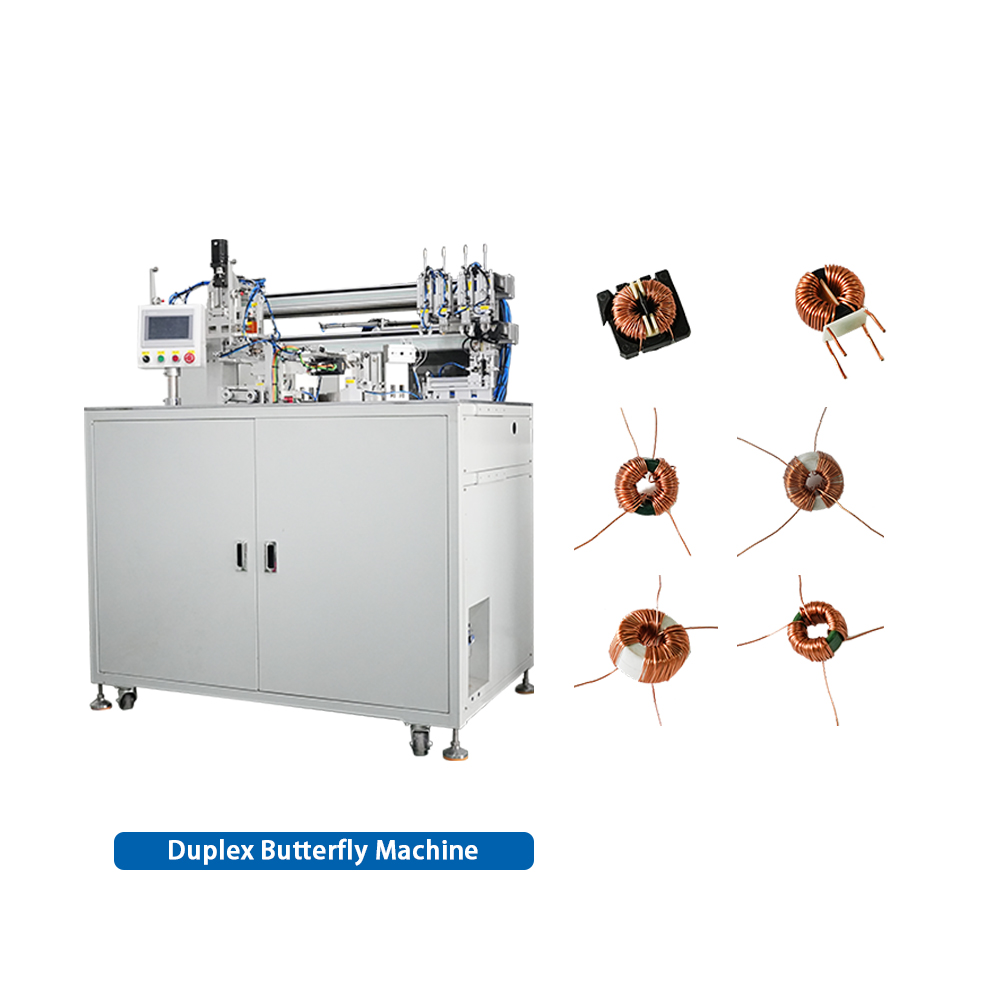
Duplex butterfly machines are used in specialized coil manufacturing, particularly for transformer windings, inductor coils, and customized electromagnetic components. Their two-section winding arrangement provides manufacturers with a dedicated solution for producing butterfly-shaped coils.
When selecting a duplex butterfly machine, manufacturers should evaluate wire compatibility, winding dimensions, turn capacity, tension control, and automation requirements to ensure the equipment matches their production needs.

Specialised in automated winding equipment and system development, production, sales and technical services as one of the high-tech enterprises.

+0769 82312151
+86 135 8090 8886
+86 132 6737 9998
3F, No.51 Minghua Road, Liangjia Village, Shijie Town, Dongguan City, Guangdong Province, China
Copyright © 2026 Dongguan Zhiqiang Electronic Technology Co., LTD | Privacy Policy | Terms and Conditions
