
2026-09-27 12:00:54
If you are searching for a coil winding machine price, the honest answer is that no single number exists — and any supplier who quotes one without asking about your coil is guessing. Two machines that look identical in a catalogue can differ by a factor of three once the tension package, fixture set and automation level are specified to your part.
What we can do is show you exactly what moves the number. Ask how much does a coil winding machine cost without describing the coil first, and you will get either a guess or a range so wide it is useless. This guide breaks down the six cost drivers behind an automatic winding machine price, explains why the first quote is rarely the final one, and sets out what to send a supplier so the number you receive is the number you actually pay.
A winding machine is not a catalogue item; it is a configuration. The base platform is often the smaller part of the cost. What changes the number most is how much of the process you want automated and how hard your coil is to wind.
Consider two customers buying what their purchase order calls "an automatic coil winder". One winds a simple 40-turn inductor on a 12 mm toroid with 0.3 mm wire, single shift, manual loading. The other winds a bifilar common mode choke with 0.08 mm wire, needs ±2% inductance consistency, runs three shifts, and wants automatic core loading. The second machine carries a fundamentally different specification — different spindle, different tension hardware, different fixture, different control logic. Publishing one price for both would be dishonest.
So the useful question is not "what does it cost" but "what does my machine cost, and which decisions move it".
In our experience quoting coil winding equipment, cost concentrates in six places. The impact column is our engineering assessment of how much each lever moves the final number.
| Cost Driver | What You Are Paying For | Impact on Price |
|---|---|---|
| Tension control system | Closed-loop servo tension with real-time correction vs. mechanical damper | High |
| Fixture and tooling | Custom core clamping, cushioned jaws for fragile ferrite or nanocrystalline cores | High |
| Automation level | Manual load vs. automatic core loading, cutting, taping and unloading | High |
| Spindle count and speed | Single vs. dual spindle, and the drive system needed for high RPM | Medium to high |
| Control and software | PLC/HMI, recipe storage, closed-loop inductance measurement, data logging | Medium |
| Wire and core range | How wide a diameter span the guides and tension hardware must cover | Medium |
Notice that the base frame and enclosure — the parts you can see in a photograph — are not on this list. They are the least differentiating cost item. This is why comparing two quotes on the photograph alone is a mistake.
Want a real number for your part? Send your coil drawing, wire gauge and target output per shift — we will quote a configured machine rather than a catalogue model. Request a configured quote.
Platform choice is the second big lever. The classes below sit in ascending order of cost, and each step buys throughput rather than accuracy — the accuracy ceiling is set by the tension and fixture package, not by the class.
| Platform Class | Typical Capability | Best Fit |
|---|---|---|
| Single spindle, manual load | Fine wire from 0.02 mm; single coil per cycle | Low to medium volume, high mix, tight budgets |
| Dual spindle automatic | Two coils per cycle, up to 1200 RPM, ±0.05 mm precision | Growing volume where labour is the constraint |
| Fully automatic with auto loading | Unattended core feed, winding, cutting and unloading | High volume, single coil family, multi-shift running |
| Application-specific platforms | Purpose-built for one coil type, e.g. ceiling fan motor stators | Dedicated lines where one product dominates output |
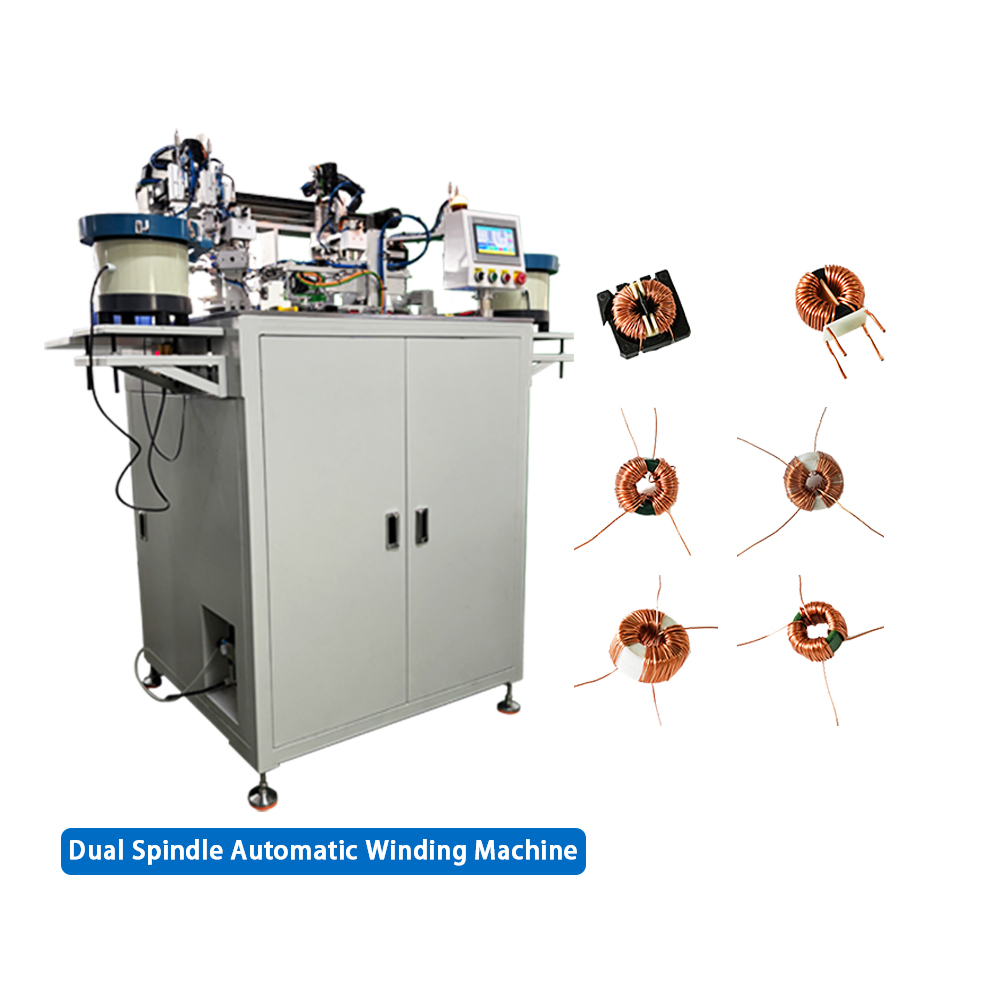
The dual spindle automatic winding machine is usually the point at which the price step is justified, because it doubles output without doubling the footprint or the operator count. Below that volume, a single-spindle platform such as the single station butterfly machine is the cheaper and often better answer. Above it, purpose-built platforms such as the ceiling fan CNC winding machine start to pay back quickly.
The same logic explains why a motor winding machine price and an electric motor winding machine price are rarely the same number, even when both refer to the same platform class. On motor work the cost sits in the stator fixture, the slot count and the wire gauge spread — a machine configured for one stator family is a different machine from one built to change over between six. A transformer winding machine price behaves the same way, because layer insulation and interleaving requirements add winding passes and control complexity. In ceiling fan production, a fan coil winding machine price or a CNC ceiling fan winding machine price depends far less on the frame than on whether the platform is dedicated to a single stator family or expected to flex between models.
Most unpleasant surprises in winding machine procurement are not price increases — they are scope the buyer did not realise was excluded. Before you compare two quotes, check whether each one includes:
Fixtures for every coil variant you run, not just the sample
Tension hardware matched to your finest wire, not the base configuration
Winding programs developed and proven on your cores, not just a machine that can be programmed
Acceptance testing against agreed criteria, with recorded evidence
Installation support, commissioning and operator training
A documented spare parts kit for the first year
A low headline number that excludes fixtures and program development is not a cheaper machine — it is an incomplete one. Add the missing scope back in before you decide.
Price comparison only works when the scope is identical. Normalise the offers on four axes:
| Axis | Ask Both Suppliers For |
|---|---|
| Cost per finished coil | Cycle time, plus loading and unloading time, on a coil matching your specification |
| Yield-adjusted output | Expected first-pass yield at your tolerance, so you can compare good pieces per shift rather than gross pieces |
| Scope of supply | Itemised list of what is included: fixtures, programs, spares, training, commissioning |
| Cost of ownership | Wear parts list, replacement interval and spare lead time |
The machine with the higher sticker price frequently wins on the second axis. A platform that holds ±0.05 mm and stable tension typically produces more saleable coils per shift than a cheaper unit that needs rework — and the difference compounds across every shift you run.
If you are still deciding between platforms, our guide to wire coil winding machine selection covers the specification trade-offs before you reach the quotation stage.
Quotes are only as good as the information behind them. Suppliers who receive vague enquiries either guess high to protect themselves, or quote a base machine and revise upward later. Send these seven items and you will get a number you can plan against:
| # | Information | Why the Supplier Needs It |
|---|---|---|
| 1 | Coil drawing with core dimensions (ID, OD, height) | Determines fixture design and spindle reach |
| 2 | Wire diameter and insulation type | Sets the tension range and guide hardware |
| 3 | Turns, layers and winding pattern | Drives cycle time and program complexity |
| 4 | Tolerance and electrical acceptance criteria | Defines whether closed-loop measurement is needed |
| 5 | Required output per shift or per day | Decides single vs. dual spindle and automation level |
| 6 | Number of coil variants to be produced | Sizes the fixture and tooling package |
| 7 | Loading method and operator availability | Justifies or rules out automatic core feeding |
Send the seven items above and we will return a configured price with the scope itemised, plus a trial winding proposal on your sample coil. Get your configured winding machine quote.
Budget on throughput, not on the sticker price. On a representative inductor coil, a single-station platform produces around 55 pieces per hour; a dual-station machine roughly doubles that to 110 pieces per hour. Divide the quoted price by the number of saleable pieces your line will produce per shift and the comparison between two offers usually looks very different from the headline numbers.
Typical lead time is about 15 days for a standard configuration. Orders that need new fixtures, a trial winding round, or unusually high quantities extend that timeline. The delivery date is written on the quotation, so include it in your cost comparison — a cheaper machine that arrives three weeks later is not always the cheaper option once your line is waiting.
Yes. We currently supply customers in Brazil, India, the Philippines, Singapore, Iran, South Korea and Pakistan, as well as the domestic Chinese market. If you need a reference from a nearby market, ask us during the quotation stage.
A coil winding machine price is a function of configuration, not of brand or catalogue position. The six drivers that matter — tension control, fixtures, automation level, spindle count and speed, control software, and wire range — are all decisions you make, not prices imposed on you. Decide which ones your coil genuinely requires, normalise competing quotes on cost per good coil rather than sticker price, and send suppliers enough information to quote accurately the first time. That is how you avoid both overpaying for automation you do not need and underpaying for a machine that cannot hold your tolerance.

Specialised in automated winding equipment and system development, production, sales and technical services as one of the high-tech enterprises.

+0769 82312151
+86 135 8090 8886
+86 132 6737 9998
3F, No.51 Minghua Road, Liangjia Village, Shijie Town, Dongguan City, Guangdong Province, China
Copyright © 2026 Dongguan Zhiqiang Electronic Technology Co., LTD | Privacy Policy | Terms and Conditions
